
Blog
Best Flashcard Apps: When Anki Is Not the Best
Compare Anki alternatives and modern spaced repetition apps to find the best flashcard tool for your learning style.
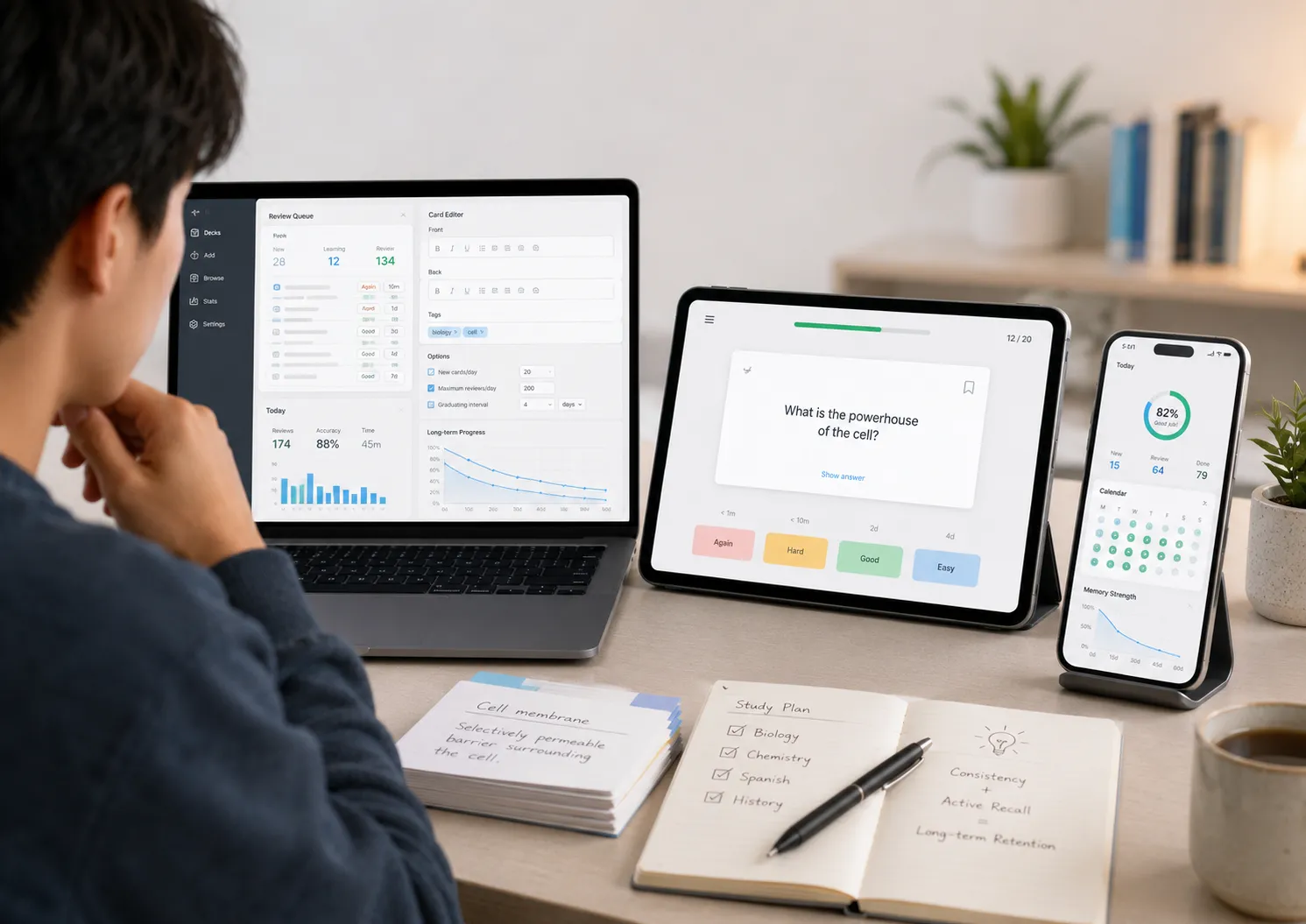
Choosing a flashcard app is not only about comparing features. The application you choose affects how quickly you can start studying, how often you review, how much time you spend configuring your system, and whether you continue using it after the first week.
Anki remains one of the most powerful flashcard applications available. It is mature, flexible, highly customizable, and supported by a large ecosystem of shared decks and add-ons. For many serious learners, it is still an excellent choice.
But Anki is not automatically the best flashcard app for everyone.
Some learners need advanced templates and complete control. Others want modern spaced repetition without plugins, complicated settings, or an interface that takes time to understand. The best choice depends on your subject, technical confidence, study habits, devices, and preferred workflow.
TL;DR: The best flashcard app by learner type
- Choose Anki if you want maximum customization, advanced card templates, add-ons, and control over a large collection.
- Choose SpaceRep if you want FSRS-based scheduling with less setup and a cleaner daily workflow.
- Choose RemNote if you want flashcards integrated with connected notes, outlines, and knowledge management.
- Choose Quizlet if you value familiar study modes, shared sets, and quick classroom-style practice.
- Choose Brainscape if you prefer a polished, structured system based on confidence ratings.
There is no universal winner. The best flashcard application is the one that gives you enough learning power without adding friction that stops you from studying consistently.
What matters in a flashcard application?
Feature lists often focus on images, tags, imports, audio, shared decks, and card templates. Those details can be important, but they do not fully explain whether an app will work well in daily use.
A useful comparison should consider the following factors.
Scheduling quality
A spaced repetition scheduler estimates when a memory is becoming difficult to retrieve and schedules a review before it is likely to disappear completely.
A strong scheduler can reduce unnecessary repetition while still supporting long-term retention. It should respond to your actual review history rather than applying identical intervals to every card.
The algorithm is only part of the experience, however. The application also needs sensible defaults, understandable controls, and a review process that does not make the learner feel responsible for managing every technical detail.
Setup time
Some learners enjoy configuring card templates, retention targets, review steps, deck presets, keyboard shortcuts, and plugins. Others want to create a card and begin studying immediately.
Neither approach is inherently more serious.
A medical student managing a large, specialized deck may benefit from deep control. A language learner studying for 20 minutes each evening may gain more from an app that works well without extensive setup.
Card complexity
Simple vocabulary cards may require only a word, a definition, and perhaps audio. Medical, mathematical, scientific, and technical subjects can require equations, images, code, diagrams, cloze deletions, multiple fields, or carefully formatted explanations.
The more complex your material becomes, the more valuable flexible card creation and reliable formatting become.
Mobile, web, and offline access
A flashcard system becomes more useful when it works wherever you have time to study: on a train, between lectures, during lunch, or at a desktop browser.
Consider whether the application offers:
- reliable synchronization across devices;
- useful iOS and Android apps;
- offline review;
- a complete browser-based study experience;
- convenient card creation and editing on mobile.
A weak mobile experience can undermine an otherwise powerful study system.
Workflow fit
Some applications focus entirely on flashcards. Others combine flashcards with notes, quizzes, games, classroom tools, documents, or knowledge management.
More features are not always better. A broad platform can be valuable when you use its wider workflow, but it can also add unnecessary menus and concepts when all you need is focused review.
Long-term maintainability
A collection of 30 cards is easy to manage almost anywhere. A collection of 10,000 cards is different.
Before committing to an app, consider how easily you can organize, search, edit, export, back up, and migrate your material. A system that feels convenient during the first week may become difficult to maintain after several years.
Comparing the major flashcard apps
| App | Best for | Main strength | Main trade-off |
|---|---|---|---|
| Anki | Power users and complex subjects | Customization, templates, add-ons, and a mature ecosystem | Steeper learning curve and more configuration |
| RemNote | Learners combining notes and flashcards | Connected notes, outlines, and integrated review | Can be more system than a flashcard-only learner needs |
| Quizlet | Classroom study and shared sets | Familiar interface and varied study modes | Less focused on rigorous long-term review management |
| Brainscape | Learners who prefer guided structure | Polished confidence-based repetition | Less transparent and configurable than FSRS-based systems |
| SpaceRep | Learners seeking modern scheduling with less friction | Strong scheduling and simpler daily review | Usually fewer advanced customization options |
Anki: maximum control
Anki is still one of the strongest options for serious flashcard users. It works across major platforms, supports synchronization, and can handle everything from simple vocabulary to highly specialized medical and technical cards.
Its note-and-card system allows one set of information to generate multiple card types. Advanced users can create custom fields, templates, styling rules, cloze deletions, and automated workflows. A large community has also created add-ons for statistics, card creation, interface changes, image occlusion, and other specialized needs.
Anki can support FSRS, so it would be inaccurate to describe it as limited to an older scheduling model. Learners can use modern scheduling while retaining Anki’s extensive customization options.
The trade-off is complexity.
New users may need to understand notes, cards, fields, templates, decks, presets, learning steps, retention settings, synchronization, and add-ons before they feel confident. Community guides can help, but they can also make it difficult to distinguish essential configuration from personal optimization.
Anki is powerful partly because it exposes so many decisions. For some learners, that is an advantage. For others, it becomes a barrier.
RemNote: notes and flashcards together
RemNote is particularly useful when flashcards should emerge directly from structured notes.
A learner can write an outline, connect related concepts, and convert selected information into scheduled cards without maintaining a separate note-taking and flashcard system. This can work well for university courses, research-heavy subjects, and topics where understanding relationships is as important as remembering individual facts.
It is also useful for learners who want to build a long-term knowledge base rather than a collection of isolated cards.
The trade-off is scope. Documents, references, linked concepts, portals, and knowledge-management features can be valuable, but they also introduce more concepts to learn. If you already use another note-taking application or only want focused flashcard review, RemNote may feel broader than necessary.
Quizlet: easy and familiar
Quizlet makes it easy to create or find a set and start studying quickly. Its large library of public material is particularly useful when teachers, classmates, or other learners already share sets on the platform.
In addition to traditional flashcards, Quizlet offers several practice formats. This variety can help learners who prefer short quizzes, matching activities, or guided practice instead of repeating the same review interaction every day.
It is a practical choice for school courses, vocabulary practice, collaborative studying, and short-term exam preparation.
However, the overall experience is less centered on maintaining a large personal spaced repetition system over many years. Learners who want explicit retention targets, detailed scheduling controls, and a focused long-term review workflow may prefer a more specialized application.
Brainscape: structured confidence-based review
Brainscape uses confidence ratings to guide repetition. After viewing an answer, you rate how confidently you knew it, and the system uses that rating to determine how soon the card should return.
This approach is easy to understand and creates a clear review rhythm. The interface is polished, and the workflow may feel more approachable than a highly configurable Anki setup.
The main limitation is that confidence is not identical to recall quality. A learner can feel confident while remembering an answer incorrectly or incompletely. Someone else may recall the essential idea but give themselves a low rating because the wording was not exact.
Its proprietary approach also provides less visibility than an open, parameter-driven scheduler such as FSRS. Some learners will appreciate the simplicity, while others will prefer a system that explains its memory model more clearly.
Why Anki is not always the best
Anki’s strengths are real, but each strength has a corresponding cost.
Its flexibility creates more decisions. Its add-on ecosystem expands what the app can do, but plugins can require maintenance and may become incompatible after updates. Its mature interface exposes advanced controls, but beginners can find it dated or intimidating.
These issues are not merely cosmetic. Friction changes study behavior.
A learner who spends several evenings researching optimal settings has not necessarily improved retention. A student who avoids opening an app because every session feels like managing a technical system gains little from having the most powerful software.
A simpler app used consistently can be more effective than an advanced app that is repeatedly postponed.
Anki may not be the best fit when you:
- want useful defaults without studying the application itself;
- prefer a modern, calm interface with fewer visible controls;
- do not need add-ons or complex templates;
- want synchronization, mobile review, offline access, and web study to feel like one cohesive product;
- are likely to abandon a system when setup becomes complicated;
- want the scheduler to work well without frequent adjustment.
Anki remains difficult to beat when you need:
- specialized note types;
- advanced card-generation rules;
- extensive keyboard workflows;
- complex formatting;
- a large ecosystem of community decks;
- plugins for a specific academic workflow;
- detailed control over a very large collection.
The fair conclusion is not that Anki is outdated or ineffective. It is that its power is most valuable when you genuinely need that level of control.
Modern spaced repetition and FSRS
FSRS stands for Free Spaced Repetition Scheduler. It models memory using factors including difficulty, stability, and retrievability.
- Difficulty represents how hard a particular item is for you.
- Stability estimates how long the memory can remain retrievable.
- Retrievability estimates the probability that you can recall it at the current moment.
After each review, the scheduler updates its estimate and calculates a future interval based on your answer, review history, and desired retention.
This is more adaptive than applying the same interval rules to every card. A difficult anatomy relationship that you repeatedly forget should not follow the same schedule as a familiar vocabulary word you recall effortlessly.
FSRS can also help reduce unnecessary reviews. The learner chooses a desired retention target, and the scheduler balances that target against review workload. A higher retention target generally creates more frequent reviews. A lower target accepts slightly more forgetting in exchange for fewer repetitions.
The practical goal is not to show every card as often as possible. It is to review each card often enough to support the level of retention you need.
However, even an advanced scheduler cannot rescue poor flashcards. Effective cards should still:
- test one clear idea;
- require genuine retrieval;
- avoid giving away the answer;
- include enough context to prevent ambiguity;
- use concise answers where possible;
- be corrected when they repeatedly cause confusion.
Scheduling determines when a card returns. Card quality determines what you learn from the review.
It is also important to separate the scheduler from the product experience. Anki can use FSRS and offers extensive control over it. Other applications can use the same modern principles while offering simpler defaults, fewer settings, and a more guided workflow.
The best implementation depends on whether you want to manage the scheduler or simply benefit from it.
Which flashcard app should you choose?
The best flashcard app depends on how much customization you need, whether your cards should connect to notes, and how much time you want to spend configuring your study system.
Match the application to your actual workflow rather than choosing the platform with the longest feature list.
Choose Anki for maximum customization
Choose Anki when you need advanced templates, community add-ons, detailed deck settings, or complete control over a large flashcard collection.
It is particularly suitable for medical students, technical learners, and experienced users who work with complex formatting, shared decks, or specialized review processes.
Anki is also a strong choice when you enjoy refining tools and expect the customization to save time over several years. The initial learning curve can be worthwhile when your subject demands features that simpler applications cannot provide.
Choose SpaceRep for modern spaced repetition without the setup burden
This option is designed for learners who want an Anki alternative that combines serious long-term scheduling with a cleaner, more approachable experience.
It uses FSRS to schedule reviews based on memory stability, difficulty, and retrievability. The aim is to protect retention while avoiding reviews that are not yet necessary.
It is a strong fit for students, language learners, medical learners, and technical learners who want:
- modern FSRS-based scheduling;
- fewer unnecessary reviews;
- a simple, distraction-free interface;
- cloud synchronization across devices;
- browser-based study on the web;
- mobile learning on iOS and Android;
- offline review without a constant internet connection;
- less time spent configuring decks, plugins, and scheduling settings.
It does not try to reproduce every advanced Anki customization. That is part of its appeal for learners who want Anki-level seriousness about memory without turning their study application into a technical project.
For someone searching for the best spaced repetition app but finding Anki intimidating or configuration-heavy, it offers a focused middle ground between basic flashcard tools and highly customizable systems.
Choose RemNote for integrated notes
Choose RemNote when flashcards are only one part of a broader knowledge-management workflow.
It is especially useful when you want to write lecture notes, connect concepts, organize sources, and schedule selected information for review inside the same application.
RemNote may be the better choice when understanding relationships between ideas is central to your subject. It may be less suitable when you already have a note-taking system and only need a focused flashcard app.
Choose Quizlet for quick, familiar studying
Choose Quizlet when ease of use, public study sets, and varied practice modes matter more than advanced scheduler control.
It works well for classroom learning, shared vocabulary sets, short courses, and exam preparation. It is also a practical option when your teacher or study group already uses the platform.
Learners building a personal review system for several years may prefer a more specialized spaced repetition app.
Choose Brainscape for guided review
Choose Brainscape when you prefer a polished and structured workflow based on confidence ratings.
Its review process is straightforward and may feel more approachable than configuring decks, templates, and scheduler settings. It is a reasonable choice for learners who want guided repetition without a full knowledge-management system.
Learners who want a transparent memory model or detailed control over scheduling may prefer an FSRS-based alternative.
Test the workflow before committing
Before choosing an app, test your two strongest candidates with material you genuinely need to learn:
- Create 20 to 30 cards from a real course, language lesson, or technical topic.
- Study them on both desktop and mobile.
- Edit several cards after noticing unclear questions or incomplete answers.
- Check how the app handles missed days and overdue reviews.
- Notice how much configuration is required before studying feels comfortable.
- Decide whether you could realistically continue the workflow for six months.
A useful rule is:
- Choose Anki for control and customization.
- Choose SpaceRep for modern scheduling with less friction.
- Choose RemNote for connected notes and knowledge management.
- Choose Quizlet for accessible study modes and shared sets.
- Choose Brainscape for structured confidence-based repetition.
The best Anki alternative is not necessarily the app with the most features. It is the one that preserves effective retrieval practice and spaced repetition while removing the friction that would otherwise stop you from studying.
FAQ
Is Anki still the best flashcard app?
Anki remains one of the best options for customization, advanced cards, add-ons, and large collections. It is not automatically the best for learners who prioritize simplicity, modern design, or minimal setup.
Does Anki support FSRS?
Yes. Modern Anki versions can use FSRS. Learners can select a desired retention target and use their review history to optimize scheduling parameters.
What is the best Anki alternative?
The best Anki alternative depends on what you dislike about Anki. Choose SpaceRep if you want simpler FSRS-based spaced repetition, RemNote for integrated notes, Quizlet for shared study sets, or Brainscape for guided confidence-based review.
Is RemNote better than Anki?
RemNote may be better when you want connected notes and flashcards in one system. Anki may be better when you need deeper customization, specialized templates, or a larger add-on ecosystem.
What is the best spaced repetition app for beginners?
Beginners often benefit from an app with sensible defaults, a clear review interface, reliable synchronization, and minimal setup. Advanced customization matters less when it prevents you from building a consistent study habit.
FAQ
Is Anki still the best flashcard app?
Anki remains one of the best options for customization, advanced cards, add ons, and large collections. It is not automatically the best for learners who prioritize simplicity, modern design, or minimal setup.
Does Anki support FSRS?
Yes. Modern Anki versions can use FSRS. Learners can select a desired retention target and use their review history to optimize scheduling parameters.
What is the best Anki alternative?
The best Anki alternative depends on what you dislike about Anki. Choose SpaceRep if you want simpler FSRS based spaced repetition, RemNote for integrated notes, Quizlet for shared study sets, or Brainscape for guided confidence based review.
Is RemNote better than Anki?
RemNote may be better when you want connected notes and flashcards in one system. Anki may be better when you need deeper customization, specialized templates, or a larger add on ecosystem.
What is the best spaced repetition app for beginners?
Beginners often benefit from an app with sensible defaults, a clear review interface, reliable synchronization, and minimal setup. Advanced customization matters less when it prevents you from building a consistent study habit.
Keep Reading
Related articles
FSRS
What Is FSRS? A Simple Guide
Learn what FSRS is, how it schedules flashcards, and why it can reduce review overload without a math-heavy explanation.
Apr 16, 2026
Learning
Best Learning Techniques for Remembering More
A practical guide to active recall, spaced repetition, interleaving, elaboration, practice testing, and smarter note review.
Jun 19, 2026
flashcards
How to Create Flashcards That Actually Help You Learn
Learn how to write better flashcards using active recall, retrieval practice, spaced repetition, and a practical FSRS workflow.
Apr 5, 2026