
Blog
Best Learning Techniques for Remembering More
A practical guide to active recall, spaced repetition, interleaving, elaboration, practice testing, and smarter note review.
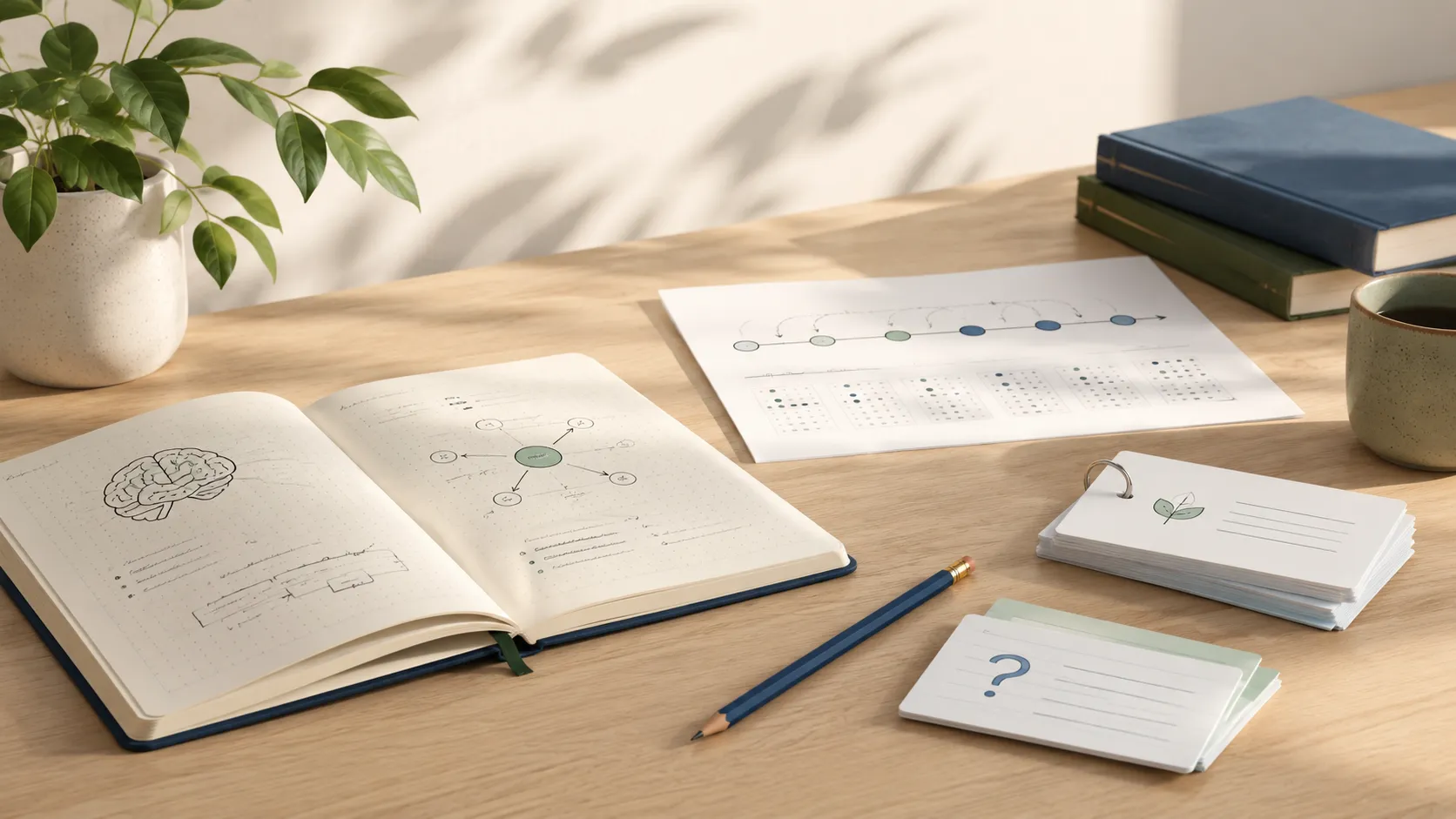
Your notes can feel familiar long before the material is actually available in your memory. That is one of the biggest traps in studying: recognition feels like learning, but exams, projects, interviews, and real work usually require recall.
TL;DR: The best learning techniques make your brain retrieve, explain, compare, and apply information. Rereading and highlighting can support understanding, but they are usually weaker than active recall, spaced repetition, interleaving, elaboration, and practice testing when your goal is to remember what you study.
Why familiar notes can fool you
When you reread a chapter, review a slide deck, or look over neatly highlighted notes, the material starts to feel smooth. You recognize the wording. You remember where things appear on the page. You may even think, “Yes, I know this.”
But recognition is not the same as recall.
Recognition means the information feels familiar when it is in front of you. Recall means you can produce it without seeing it. Most real learning tasks depend more on recall than recognition. You need to explain a concept in your own words, solve a problem from a blank page, remember a term during a test, or apply a method in a new situation.
That is why effective study methods often feel less comfortable than passive review. They create a little friction. They reveal gaps. They force you to notice what you can and cannot bring back from memory.
A good study routine does not eliminate notes. It uses notes in the right place: first to understand, later to check and correct. The main work of remembering comes from retrieval, spacing, variation, and application.
Active recall: practice bringing knowledge back
Active recall means trying to retrieve information from memory before looking at the answer. Instead of asking, “Do I recognize this?”, you ask, “Can I produce this?”
This can be as simple as closing your notes and writing down what you remember. It can also mean answering flashcards, explaining a concept out loud, drawing a process from memory, or solving a problem without looking at examples.
For concepts, active recall might look like this:
- After studying opportunity cost, close the textbook and explain it using a real-life example.
- After learning photosynthesis, sketch the main inputs, outputs, and stages from memory.
- After reading about cognitive biases, name three biases and describe how each might affect a decision.
For facts, active recall is more direct:
- What is the capital of Argentina?
- What does “mitosis” mean?
- Which command lists files in a directory?
- What is the formula for compound interest?
For problem-solving subjects, active recall becomes active production. You do not just remember a definition; you recreate a method. In math, physics, programming, accounting, or statistics, the key question is not “Do I understand the worked example?” but “Can I solve a similar problem without the worked example?”
A practical rule: after every study session, spend at least a few minutes testing yourself before you reread. If you cannot recall much, that is not failure. It is useful feedback.
Spaced repetition: return before forgetting wins
Spaced repetition means reviewing information across increasing intervals instead of cramming it all at once. You might review something later today, then tomorrow, then several days later, then next week.
The point is not to review everything constantly. The point is to revisit material at useful moments: after some forgetting has started, but before the memory becomes too weak. That effortful retrieval strengthens long-term memory more than repeatedly seeing the same material in one sitting.
Spaced repetition works especially well for:
- vocabulary
- definitions
- formulas
- dates
- anatomy terms
- legal rules
- programming syntax
- key concepts that must stay available over time
It also works for bigger ideas, as long as you turn them into useful prompts. Instead of making a vague card like “Chapter 4”, ask a question such as, “Why does increasing the sample size usually reduce sampling error?” or “What problem does normalization solve in a database?”
A spaced routine can be simple:
- Learn the material once with notes, examples, or a lesson.
- Create a small number of questions that require recall.
- Review those questions over several days or weeks.
- Mark what you missed and return to the source only when needed.
This is where many learners lose consistency. They understand the idea of spacing, but they do not turn it into a daily habit. SpaceRep helps turn active recall and spaced repetition into a practical daily workflow, so review becomes a scheduled part of learning rather than a vague intention.
Interleaving: mix related skills to improve judgment
Interleaving means mixing related problem types or topics instead of practicing only one type at a time.
Blocked practice looks like this:
- 20 problems on method A
- then 20 problems on method B
- then 20 problems on method C
Interleaved practice looks like this:
- A, C, B, A, B, C, C, A, B
Blocked practice often feels better while you are doing it because you know which method to use. Interleaving feels harder because you first have to decide what kind of problem you are facing. That difficulty is the point. In real tests and real work, the method is rarely labeled for you.
Interleaving is especially useful for problem-solving subjects:
- In math, mix equation types instead of doing one formula for a whole page.
- In language learning, mix tenses or sentence patterns instead of drilling only one structure.
- In medicine or law, compare similar diagnoses, rules, or cases.
- In programming, solve small tasks that require choosing between loops, recursion, data structures, or built-in functions.
Interleaving does not mean random chaos. It works best when the topics are related enough to be confused with each other. The goal is to improve discrimination: knowing not just how to use a method, but when to use it.
Use blocked practice when you are first learning a new procedure. Use interleaving once you have the basics and need flexible performance.
Elaboration: connect ideas instead of memorizing them alone
Elaboration means explaining why something is true, how it connects to other ideas, and where it applies. It turns isolated information into a network.
A shallow question is: “What is this term?”
An elaborative question is: “Why does this term matter, what is an example, and how is it different from a similar term?”
For example, if you study “inflation”, you could memorize a definition. That may be enough for a basic quiz. But elaboration makes the concept more usable:
- What causes inflation in different situations?
- How is inflation different from a one-time price increase?
- Why might moderate inflation be treated differently from hyperinflation?
- How would inflation affect a student, a retiree, or a business?
Elaboration is powerful for concepts because it creates meaning. It is also useful for facts when the fact is not completely arbitrary. A historical date becomes easier to remember when you connect it to what came before and after. A biology term becomes easier when you connect the word parts to the function. A programming concept becomes clearer when you compare it to a similar pattern.
A quick elaboration prompt is:
“This matters because…”
After reading a section, finish that sentence in your own words. If you cannot, you may have copied the idea without understanding it.
Practice testing: use tests as learning tools
Practice testing is one of the most practical ways to study because it combines retrieval, feedback, and application. A test does not have to be formal. It can be a past paper, a quiz, a blank-page summary, a set of practice problems, or questions you wrote yourself.
The key is to answer before checking.
Many learners use practice tests too late, only when they feel “ready.” A better approach is to use small tests earlier. They show you what your brain can actually do with the material.
For factual subjects, practice testing may mean short-answer questions. For conceptual subjects, it may mean explaining ideas without notes. For problem-solving subjects, it means solving new problems and checking your reasoning, not just your final answer.
A good practice test cycle looks like this:
- Try the question under realistic conditions.
- Check the answer.
- Identify the exact error.
- Correct the misunderstanding or missing step.
- Test the same idea again later, not immediately forever.
The mistake review is where much of the learning happens. Do not only mark answers right or wrong. Ask what kind of error it was:
- Did you forget a fact?
- Did you misunderstand the concept?
- Did you choose the wrong method?
- Did you make a careless execution error?
- Did you know the answer only after seeing a hint?
Each error type needs a different fix. Forgotten facts may need spaced recall. Misunderstood concepts may need explanation and examples. Wrong method choices may need interleaving. Careless errors may need slower checking routines.
Note review still has a place
Rereading is not useless. It is just often overused.
Note review helps when you are building initial understanding. If a topic is new, you need explanations, examples, diagrams, and worked solutions. You cannot retrieve what you have not understood or encoded in the first place.
Note review also helps after retrieval. When you try to answer from memory and fail, notes help you correct the gap. In that order, notes become feedback instead of a comfort blanket.
Use note review for three main jobs:
- Initial understanding: Read, watch, or listen carefully enough to grasp the idea.
- Gap checking: After recall, compare your answer with the source.
- Mistake correction: Fix wrong assumptions, missing details, or weak explanations.
The weaker version of note review is passive rereading with no question in mind. The stronger version is targeted review after you have tried to recall or apply something.
Instead of rereading a whole chapter, ask:
- What did I fail to remember?
- Which part of my explanation was vague?
- What example would make this clearer?
- Which mistake did I just make, and why?
This keeps notes in the learning process without letting them replace learning.
What should you do today?
Different techniques solve different problems. Use this checklist to choose the right method for your current study goal.
| If your problem is… | Use this today |
|---|---|
| “I recognize it, but I cannot explain it.” | Active recall plus elaboration |
| “I forget it after a few days.” | Spaced repetition |
| “I know the method when the chapter is labeled.” | Interleaving |
| “I understand examples but cannot solve new problems.” | Practice testing |
| “I keep mixing up similar ideas.” | Interleaving plus comparison notes |
| “My notes are messy and I feel lost.” | Focused note review for initial understanding |
| “I make the same mistakes repeatedly.” | Error review plus delayed retesting |
A compact workflow after a study session:
- Close your notes. Write or say the main ideas from memory.
- Create questions. Turn important facts, concepts, and procedures into prompts.
- Check gaps. Reopen your notes only after trying to recall.
- Correct one mistake. Identify the most important misunderstanding or missing step.
- Schedule review. Revisit the material tomorrow, then later in the week.
- Mix practice. Once basics are stable, combine related problem types.
- End with one application. Use the idea in an example, problem, or explanation.
Here is a simple example.
After studying a psychology chapter on memory, you might close the book and write the difference between encoding, storage, and retrieval. Then you create questions such as, “Why can recognition feel easier than recall?” and “What is an example of retrieval practice?” You check your notes, correct weak answers, and schedule those questions for review. Later, you mix them with related topics like attention, forgetting, and study strategies.
For a problem-solving subject like calculus, the workflow looks different but follows the same logic. After learning a derivative rule, you solve one example without looking. Then you mix it with older rules so you must choose the method. When you make an error, you record whether the issue was choosing the wrong rule, applying it incorrectly, or making an algebra mistake.
The best learning techniques are not complicated in theory. The challenge is using them consistently and choosing the right one for the situation.
FAQ
What is the best learning technique overall?
Active recall is a strong starting point because it directly trains the skill of bringing information back from memory. For long-term retention, it becomes much stronger when combined with spaced repetition.
Is rereading always a bad study method?
No. Rereading helps when you are first trying to understand something or when you need to check a gap after testing yourself. It becomes weak when it is the main method and you never practice recall.
How can I remember what I study for longer?
Review the material over time, not only in one session. Use spaced repetition, answer questions from memory, and return to mistakes after a delay so you know the learning is holding.
Which method works best for problem-solving subjects?
Practice testing and interleaving are especially useful. You need to solve new problems, choose the right method, and review errors carefully instead of only rereading worked examples.
How long should a review session be?
A useful review session can be short. Ten focused minutes of answering questions from memory is often more valuable than thirty minutes of passive rereading. The goal is not long study time; it is high-quality retrieval and correction.
FAQ
What is the best learning technique overall?
Active recall is a strong starting point because it directly trains the skill of bringing information back from memory. For long term retention, it becomes much stronger when combined with spaced repetition.
Is rereading always a bad study method?
No. Rereading helps when you are first trying to understand something or when you need to check a gap after testing yourself. It becomes weak when it is the main method and you never practice recall.
How can I remember what I study for longer?
Review the material over time, not only in one session. Use spaced repetition, answer questions from memory, and return to mistakes after a delay so you know the learning is holding.
Which method works best for problem solving subjects?
Practice testing and interleaving are especially useful. You need to solve new problems, choose the right method, and review errors carefully instead of only rereading worked examples.
How long should a review session be?
A useful review session can be short. Ten focused minutes of answering questions from memory is often more valuable than thirty minutes of passive rereading. The goal is not long study time; it is high quality retrieval and correction.
Keep Reading
Related articles
FSRS
What Is FSRS? A Simple Guide
Learn what FSRS is, how it schedules flashcards, and why it can reduce review overload without a math-heavy explanation.
Apr 16, 2026
flashcards
How to Create Flashcards That Actually Help You Learn
Learn how to write better flashcards using active recall, retrieval practice, spaced repetition, and a practical FSRS workflow.
Apr 5, 2026
Flashcards
Best Flashcard Apps: When Anki Is Not the Best
Compare Anki alternatives and modern spaced repetition apps to find the best flashcard tool for your learning style.
Jul 18, 2026